
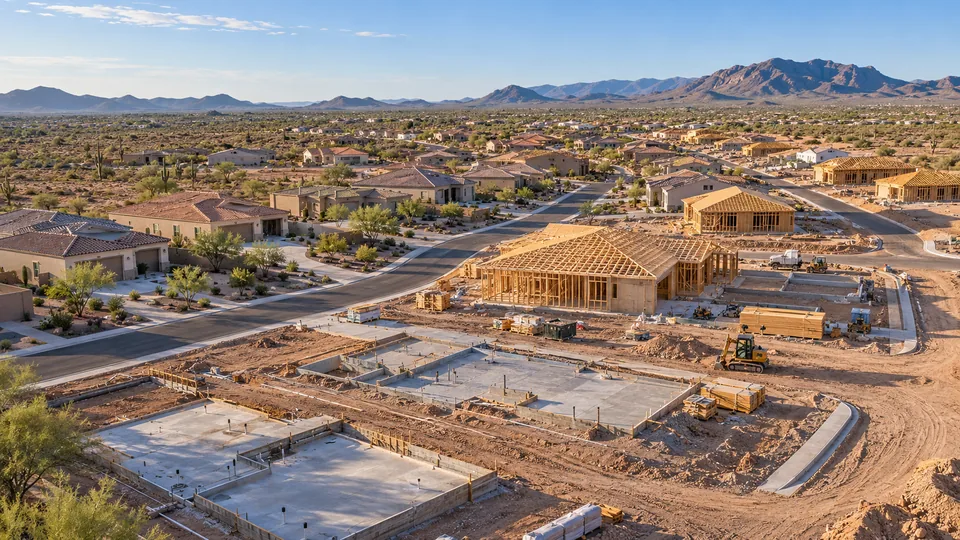
125 Percent Before the Final Plat
The Engineering Division's Financial Assurance Application Packet, with requirement pages footed ENG 02/2025, tells developers to submit financial assurance of 125 percent of the approved estimate, in the form of a bond or cash. The bond must reach the city before the associated final plat is approved and recorded, or before a dry utility project is approved. A contractor's official bid can stand in for a sealed engineer's estimate, which helps when the site work is already priced. Confirm the current code wording and submittal timing with the city before scheduling the plat.
The packet's bond form, footed ENG 11/2019, calls for a surety holding an Arizona certificate of authority and a bond executed under Title 34, Chapter 2, Article 2 of the Arizona Revised Statutes. It ties the surety's duty to a claim stating that the principal has been in default for over 90 days. For underwriting, the 25 percent margin above the estimate matters: a $6 million estimate becomes a $7.5 million bond, and the surety typically weighs the full penal sum against the developer's working capital and the principals' indemnity.
State-level rules on improvement security are explained in Arizona subdivision assurance bonds.
Ten Percent Maintenance Assurance and the Trench Extension
After construction, the packet calls for a maintenance bond or cash of 10 percent of the actual cost to construct, not the original estimate, backing a two-year warranty. The submittal includes lien releases or a title report, as-built drawings and a reconciliation of actual cost, so the closeout file should be ready before the surety is asked to write the bond.
The 2025 EDS can lengthen that obligation. Section 10.3.4 says that where significant trench failures occur, an extended warranty of two additional years is given, for four years in total, and the extension can reach a whole street, block, parcel or project. Utility repair or replacement permits under Section 10.4.8 carry their own two-year warranty. A maintenance bond priced for two years may need to stay open for four, which affects bond premium, the surety's exposure and the indemnity the developer has signed, so ask the surety in advance how it handles an extension.
Term, premium and release questions are covered under maintenance and warranty bonds.
When the Warranty Clock Starts: Two City Documents
Two city documents describe the start of the warranty differently. Section 10.5.6 of the 2025 EDS starts the two-year warranty on the date of the Conditional Acceptance letter. The Project Closeout Guide for parcel subdivision and right-of-way improvements, a September 2026 file with no printed date, starts the warranty at the inspector's construction sign-off, then moves the start to the Conditional Acceptance letter date if the Notice of Completion requirements and the warranty assurance are not completed within 180 days of that sign-off.
This page does not try to reconcile the two. The difference can shift the warranty end date by months, which in turn moves the final walk, the bond release and the period a subcontractor's own warranty must cover. Confirm in writing with the Engineering Division which start date applies to your project, and match the subcontract warranty terms to that answer.
Broader planning for bond lines and closeout is discussed in Arizona developer surety and insurance planning.
Conditional Acceptance, Final Acceptance and Bond Release
The closeout guide lays out seven steps. At step 4 the warranty assurance is posted at 10 percent of actual construction cost. At step 5 the Conditional Acceptance letter includes release language for the performance bond and states the warranty start date. The final walk at step 6 is held about four months before the warranty ends, and at step 7 the Final Acceptance letter releases the warranty bond. The financial assurance packet likewise asks the developer to request release four months before the warranty ends.
The packet also says the requirement for financial guarantee runs with the land. If a parcel is sold before the improvements are accepted, the new owner posts its own assurance and the prior owner is then released. Sellers of partially improved land should plan the timing of that replacement, since their bond and indemnity typically stay open until the buyer's assurance is accepted.
Surprise sits among the West Valley cities compared on Phoenix-area agency bond rules.
Insurance Certificate Terms in the 2025 EDS
The EDS says contractors and developers must provide a certificate of insurance naming the City of Surprise as an additional insured, covering liability, auto and workers' compensation, from an insurer authorized in Arizona. The insurance must be primary and cover liability the permittee assumes, and the city gets 10 days' written notice of cancellation. The certificate stays on file until the work is complete, or until a permanent obstruction is removed. All agents, contractors and every tier of subcontractor must be listed and file their own certificates, and the permittee must defend, indemnify and hold harmless the city.
The EDS does not print dollar limits. It says the insurance is provided in the amounts established by the city, so ask the Engineering Division for the current limits before binding or renewing. Primary wording, additional insured status and the contractual liability that backs the indemnity depend on endorsements and policy terms, which can vary by carrier guidelines and programs, so check them against the city's language rather than relying on a certificate alone.
Permit security for work in public streets is compared in Arizona right-of-way permit bonds.
Dry Utility Work in the Right-of-Way
The city's Dry Utility Application, Plan Submittal and Permitting Process Packet, revised 04/2025, says applicants without a franchise agreement pay administration, review and permit fees in addition to an acceptable form of performance bond. The permit fee is a percentage of construction cost, and a separate APS trenching permit is also required. The packet does not state a bond amount or insurance limits.
Telecom, fiber and other dry utility contractors working for a developer or a provider without a franchise should confirm the bond amount and form with the city before mobilizing, and should expect the EDS trench warranty to apply where their cuts fail. Joint trenches with several utilities in one cut raise the question of who repairs a failure and whose bond responds.
Contractor-side planning is covered in bonds and insurance for Arizona civil contractors.
Water, Night Work and Growth Around Surprise
The EDS requires a Certificate of Assured Water Supply note on a plat that subdivides six or more lots, so water documentation belongs in the platting schedule alongside the performance bond. In residential zones, the EDS bars work between 9 p.m. and 5 a.m., which can stretch schedules for utility tie-ins and paving near occupied homes and should be reflected in subcontract timelines and builders risk dates.
The city describes itself as a growing city with more than 160,000 residents and is promoting a square mile of its downtown as prime for development under a developer master plan, with a Marriott SpringHill Suites listed as under construction. Nearby, the city's Project Baccara page describes a proposed data center with about 700 megawatts of natural gas generators in an industrial area north of Luke Air Force Base. The city states the project is not in Surprise; Maricopa County is the approving agency, and Surprise has asked for noise, ground fissure, subsidence and well impact studies and an emergency plan. Work on a site like that generally follows county rules, not the city's. West Valley neighbors Buckeye and Goodyear set their own bond terms, so compare each city's documents before reusing a bond plan across jurisdictions.
Projects in unincorporated areas follow Maricopa County bond and permit requirements.
Before You Ask for a Quote
What to Gather
- Approved engineer's estimate or the contractor's official bid for the public improvements
- Final plat schedule, including the assured water supply note for six or more lots
- Surety bond line, single-bond limit and the signed indemnity agreement
- Actual-cost reconciliation, lien releases or title report and as-built drawings for the maintenance bond
- Certificates of insurance for every contractor and subcontractor tier, with additional insured and primary endorsements
- Dry utility permit documents, including any APS trenching permit
What to Ask the Insurer or Surety
- Can the surety carry 125 percent of the estimate at the time the final plat goes to the city?
- Which warranty start date will the city apply: the inspector's sign-off or the Conditional Acceptance letter?
- How would the surety handle a two-year trench warranty extension on the maintenance bond?
- What insurance limits does the Engineering Division currently set for our permits?
- If we sell a parcel before acceptance, how will the buyer's replacement assurance be timed?
- Do our subcontract warranties run as long as the city's warranty could?
Quick Answer
Surprise asks for a performance bond or cash of 125 percent of the approved estimate before the final plat is approved or recorded, then a 10 percent maintenance bond or cash for a two-year warranty that can extend two more years after significant trench failures.
Common Mistake
Assuming the warranty starts on the same date in every city document. The 2025 EDS and the newer closeout guide describe different start dates, and the difference can move the final walk and the bond release.
Broker Perspective
We size the surety line to the 125 percent bond at platting, plan for a maintenance bond that may stay open four years and compare each contractor's certificate with the city's additional insured, primary and cancellation terms.
Coverage Impact
Surety credit and indemnity stay committed until the Final Acceptance letter. Trench and pavement failures after turnover typically turn to completed-operations coverage, subject to underwriting and the terms of the bonds and policies issued.
Other Phoenix Cities
Questions Buyers Ask
How large is the performance bond for a Surprise final plat?
The city's financial assurance packet asks for a bond or cash equal to 125 percent of the approved engineer's estimate, and a contractor's official bid can be used in place of a sealed estimate. The bond is due before the final plat is approved and recorded. Confirm the current amount and timing with the Engineering Division.
How long does Surprise hold a maintenance bond on public improvements?
The standard warranty is two years, backed by a bond or cash of 10 percent of actual construction cost. The 2025 EDS extends the warranty by two additional years, to four in total, where significant trench failures occur. The Final Acceptance letter releases the warranty bond after the final walk.
When does the Surprise warranty period begin?
City documents differ. The 2025 EDS starts it at the Conditional Acceptance letter date. The closeout guide dated September 2026 starts it at the inspector's construction sign-off, moving to the Conditional Acceptance letter date if closeout and the warranty assurance slip past 180 days. Ask the city which applies to your project.
What insurance limits does Surprise require on a permit certificate?
The 2025 EDS does not print dollar limits; it says the amounts are established by the city. It does require the city as additional insured, liability, auto and workers' compensation from an Arizona-authorized insurer, primary wording, 10 days' cancellation notice and separate certificates from every subcontractor tier.
Is Project Baccara subject to Surprise's bond rules?
The city's Project Baccara page states the project is not in the City of Surprise and that Maricopa County is the approving agency. County requirements generally govern work on that site, so a contractor should confirm bond and insurance terms with the county rather than relying on Surprise's documents.
Official Sources
- City of Surprise Financial Assurance Application Packet (forms 326, 355, 356 and 357), City of Surprise Public Works, Engineering Division. Requirement and FAQ pages footed ENG 02/2025, bond forms footed ENG 11/2019: performance assurance by bond or cash at 125 percent of the approved estimate, contractor's official bid accepted, due before final plat approval and recordation or dry utility approval; surety with an Arizona certificate of authority, bond under A.R.S. Title 34, Ch. 2, Art. 2, default for over 90 days; maintenance assurance at 10 percent of actual cost for a two-year warranty with lien releases or title report, as-builts and cost reconciliation; release request four months before warranty end; obligation runs with the land and transfers on sale. Verified 2026-10-26.
- City of Surprise Project Closeout Guide (Parcel Subdivision and Public Right of Way Improvements), City of Surprise Public Works, Engineering Division. Seven-step closeout (file dated September 2026, no printed date): warranty assurance at 10 percent of actual construction cost; Conditional Acceptance letter releases the performance bond and states the warranty start date; final walk about four months before warranty end; Final Acceptance letter releases the warranty bond; warranty starts at construction sign-off unless Notice of Completion and warranty assurance are not completed within 180 days. Verified 2026-10-26.
- City of Surprise Engineering Development Standards Manual, 2025 Edition, City of Surprise Engineering. Certificate of insurance naming the city as additional insured (liability, auto, workers' compensation), Arizona-authorized insurer, primary, amounts established by the city, 10 days' cancellation notice, duration, all subcontractor tiers, indemnity; 10.3.4 trench warranty extension of two additional years; 10.4.8 two-year utility repair warranty; 10.5.6 warranty from the Conditional Acceptance letter date; assured water supply plat note for six or more lots; no work 9 p.m. to 5 a.m. in residential zones. Verified 2026-10-26.
- City of Surprise Engineering Development Standards page, City of Surprise. Publishes the 2025 EDS Manual and states the standards are reviewed each year. Verified 2026-10-26.
- City of Surprise Civil Plan Review, Permitting and Fee Information, City of Surprise. City page linking the Financial Assurance Packet and the Project Closeout Checklist used for the assurance and closeout facts on this page. Verified 2026-10-26.
- City of Surprise Dry Utility Application, Plan Submittal and Permitting Process Packet, City of Surprise Engineering. Revised 04/2025: applicants without a franchise agreement pay administration, review and permit fees plus an acceptable form of performance bond; permit fee is a percentage of construction cost; separate APS trenching permit; no bond or insurance amount stated. Verified 2026-10-26.
- City of Surprise, Project Baccara, City of Surprise. Proposed data center with about 700 MW of natural gas generators in an industrial area north of Luke Air Force Base; not in the City of Surprise; Maricopa County approval; studies the city requested. Verified 2026-10-26.
- City of Surprise, About and Surprise City Center, City of Surprise. More than 160,000 residents (About page, surpriseaz.gov/about); a downtown square mile described as prime for development under a developer master plan, with a Marriott SpringHill Suites under construction. Verified 2026-10-26.
Reviewed by the Principal, Gleason Insurance Brokers, LLCUpdated

