
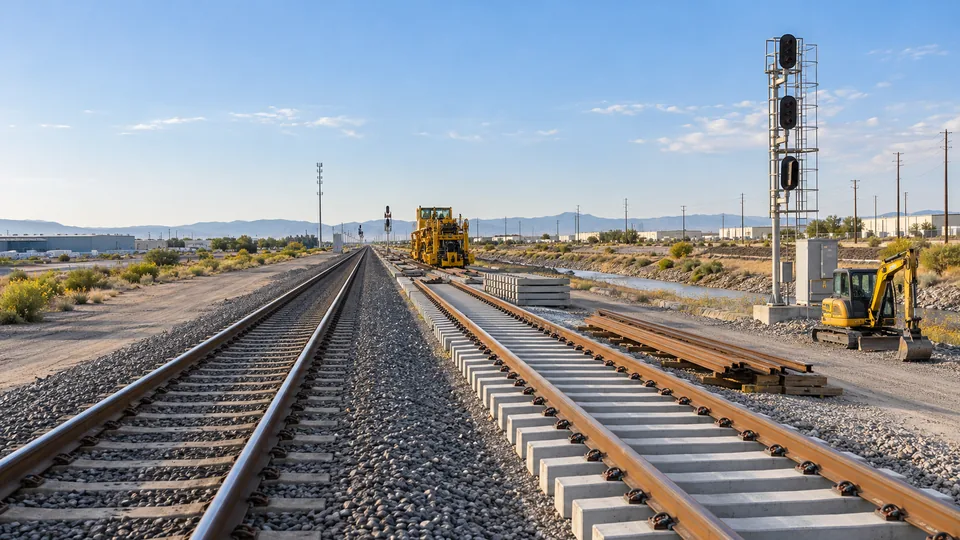
The Agreement, the Customer Number and DARTSpace
DART's property page states plainly that any use of DART property requires a license agreement, a right-of-entry agreement or both. Two divisions handle the paperwork: DART Real Estate and DART Railroad Management, which manages the Silver Line corridor, the freight corridors DART owns and, with Trinity Metro, the Trinity Railway Express between Dallas and Fort Worth.
Beginning April 21, 2025, DART moved the whole intake into its DARTSpace online application. The application, the application fee, the engineering review fee, engineering plans, checklists and proof of insurance are all submitted there, and DART states that applications cannot be processed without a DART customer number. Applicants who are unsure of their number are told to contact Real Estate or Railroad Management before filing.
The agreement comes at the end of the sequence. Once the application and insurance are approved, the DART representative sends the standard license agreement, the contractor's right-of-entry agreement or another agreement that fits the use. The applicant signs and DART countersigns. Entry is not permitted until both signatures are on it.
Older paper forms still circulate. DART has posted a standalone Standard Application for Use of DART Property whose file is titled DART-APP-05-22-13, with a 2009 copyright line and a file modification date of December 18, 2024. Because DART now routes new applications through DARTSpace, confirm with DART before relying on that PDF.
Why a railroad asks for its own separate policy is explained in our guide to railroad protective liability insurance.
DART's Construction Insurance Schedule
DART notes that insurance requirements may vary with the location and nature of the work, then lists what it typically requires for construction projects. The schedule is detailed down to the endorsement form numbers, which makes it easier to compare with a contractor's current policies before the certificate is uploaded.
- Commercial general liability: $5,000,000 per occurrence, $5,000,000 general aggregate and $5,000,000 products-completed operations aggregate, with a contractual liability endorsement.
- Additional insured status for DART and its directors, officers, representatives, contractors, agents and employees on CG 2010 (ongoing operations) and CG 2037 (completed operations) or equivalent forms.
- A contractual liability endorsement removing exclusions for operations within 50 feet of a railroad, using CG 2417 or equivalent, and removal of any exclusions for XCU hazards.
- Primary and noncontributory wording on CG 2001 and waiver of subrogation on CG 2404, or equivalents.
- Auto liability: a combined single limit of at least $2,000,000 for owned, hired and non-owned vehicles, with CA 2070 deleting exclusions for work near a railroad, CA 2048 for additional insureds, CA 0449 for primary and noncontributory and CA 0444 for waiver of subrogation, or equivalents.
- Workers' compensation with statutory Texas benefits and employer's liability at $1,000,000 for each accident, $1,000,000 each employee for disease and $1,000,000 policy limit for disease, with a waiver of subrogation on WC 42 03 04 or equivalent.
- Thirty days' notice of cancellation or modification on each policy.
When a corridor job needs higher dedicated limits than the annual program carries, compare the options for project-specific liability insurance.
Railroad Protective Liability: DART Property vs TRE and Madill Property
Railroad protective liability is a separate policy written for the railroad's benefit on the contractor's job, rather than another additional insured endorsement on the contractor's own general liability. DART's schedule reflects that: it states that DART and any railroads operating on the DART-owned corridor must be the Named Insureds on the policy. The contractor typically arranges and pays for it as a condition of the agreement.
The limits turn on whose property the work touches. For DART property, DART lists $2,000,000 per occurrence and $6,000,000 aggregate. For TRE and Madill property, it lists $5,000,000 per occurrence and $10,000,000 aggregate. A project that crosses or parallels more than one corridor may need its limits set by the highest tier involved, which is a question to settle with DART during application intake.
DART also names the parties that may need to be added, depending on the property used: Fort Worth Transportation Authority (d/b/a Trinity Metro), Dallas, Garland & Northeastern Railroad, Fort Worth & Western Railroad Company, CPKC, BNSF Railway Company, Union Pacific Railroad Company and Herzog Transit Services, Inc. Every policy must be in a form satisfactory to DART and written by insurers with a Best's rating of A-/VIII or better.
Austin's transit agency ties its railroad protection to distance from the track instead; compare the Capital Metro rail right-of-way requirements.
Application and Engineering Review Fees
DART charges a $500 nonrefundable application fee for any use of its property. Construction projects that need plan review add a $4,500 nonrefundable engineering review fee before DART will advance the application. The application fee is paid by check marked with the application number DART emails after a successful submission.
The $4,500 is a starting figure. DART warns that multiple engineering reviews, site visits or other work by its engineering consultants can bring additional charges, and that no license or right-of-entry agreement is issued until the full amount is paid. Clean first submissions matter for schedule as much as for cost.
Events and temporary uses follow a lighter schedule: general liability at $2,000,000 each occurrence with $4,000,000 in each aggregate, auto with a $2,000,000 combined single limit and the same $1,000,000 employer's liability limits. That schedule does not list railroad protective liability, so it is not a model for construction work.
Flagging, Track Training and the Track Allocation Committee
DART sets two distance triggers. On the light rail system, the foul zone is the area within 15 feet of the centerline of any light rail track or within a 10-foot radius of the overhead catenary system. Contractors who could be inside it must provide DART-certified flaggers and roadway workers-in-charge at their own expense, complete DART's Rail Transit Roadway Worker Protection training and obtain Track Allocation Committee approval.
First-time RTRWP certification takes an 8-hour in-person class and an exam, and the card expires one year after issuance. Contractors execute an RTRWP agreement at least 30 days before the class and pay a $100 training fee for each participant; classes can be requested in Spanish. The Track Allocation Committee meets in person on Wednesdays at 11:00 AM, where the contractor presents the work. Requests go through DARTSpace only after approvals, an executed agreement and the safety steps are complete, and approved work is scheduled for the following work week or later.
On railroad track, the trigger is 25 feet. Contractors working that close must provide flaggers at their cost and arrange railroad roadway worker protection training through DART Railroad Management. Flagging and training are operating costs, not insurance, but they belong in the bid alongside the premium for the railroad policy.
Regional project and permitting context for North Texas is on our page for Dallas-Fort Worth contractor insurance.
Utility Crossings: Engineering Checklists and the Plan Data Sheet
Utility contractors meet DART's engineering requirements before they meet its insurance desk. DART publishes engineering checklists meant to align designs with its Design Criteria Manual and the AREMA manual, and completed checklists must be included in all application submittals. DART says it may apply requirements beyond those on the checklists.
Separate checklists cover electrical or communication cables beneath light rail track, beneath railroad track and above railroad track; pipelines carrying flammable or non-flammable substances beneath light rail or railroad track; drainage; and highway-railway crossings. The information on DART's Plan Data Information Sheet must appear on every drawing for an underground pipeline proposed on DART or TRE property.
Projects that pose a risk to current or future transit infrastructure may also require construction oversight and as-built verification. For a bore or jack-and-bore under track, that is where the XCU language in DART's general liability requirement becomes concrete: underground work can sit inside an exclusion that DART asks to be removed, so the policy wording deserves a close read before the certificate goes in.
Insurance for the crews who do this work is the subject of our page on underground utility contractor insurance.
Before You Ask for a Quote
What to Gather
- Your DART customer number or a request to register for one
- A map showing the work against DART, TRE and Madill property and any freight track
- Distances from the work to light rail track, the overhead catenary and railroad track
- Completed DART engineering checklists and, for pipelines, the Plan Data Information Sheet
- Current general liability, auto and workers' compensation policies with their endorsement schedules
- The crew roster for RTRWP training and the flagging plan
What to Ask the Insurer or Surety
- Which railroad protective tier applies, DART property or TRE and Madill property?
- Which railroads and parties must be named on this agreement?
- Does our general liability carry CG 2417 or an equivalent, and are XCU exclusions removed?
- Does our auto policy carry CA 2070 or an equivalent near-railroad endorsement?
- Are our insurers rated A-/VIII or better by Best's?
- Is construction oversight or as-built verification expected on this project?
Quick Answer
DART typically requires $5,000,000 general liability, a $2,000,000 auto limit, $1,000,000 employer's liability and railroad protective liability of $2,000,000/$6,000,000 on DART property or $5,000,000/$10,000,000 on TRE and Madill property, filed through DARTSpace with a $500 application fee.
Common Mistake
Uploading a certificate that shows the right limits while the general liability still carries a railroad exclusion. DART asks for exclusions within 50 feet of a railroad to be removed with CG 2417 or an equivalent, and for CA 2070 on auto.
Broker Perspective
A broker reads DART's schedule against the contractor's actual endorsements and quotes the railroad protective policy at the tier that matches the property; DART alone decides the requirement and approves the agreement.
Coverage Impact
A missing endorsement or the wrong railroad protective tier can hold up the agreement, and an exclusion left on the policy may leave a near-track loss outside the contractor's own coverage.
Questions Buyers Ask
Does DART accept paper applications for right-of-way use?
DART states that, beginning April 21, 2025, applications, fees, engineering plans, checklists and proof of insurance for DART and TRE property are submitted through DARTSpace. An older PDF application is still posted, so confirm with DART Real Estate or Railroad Management before using it.
Why are DART's railroad protective limits higher on TRE property?
DART does not explain the difference on its page; it simply lists $2,000,000 per occurrence and $6,000,000 aggregate for DART property and $5,000,000 and $10,000,000 for TRE and Madill property. Confirm which tier applies to your agreement before ordering the policy.
Who must be the named insured on a DART railroad protective policy?
DART's schedule states that DART and any railroads operating on the DART-owned corridor must be the Named Insureds. Depending on the property, Trinity Metro, regional and Class I railroads or Herzog Transit Services may also need to be listed as additional insureds.
How far from DART light rail track do flagging rules start?
DART's foul zone reaches 15 feet from the centerline of any light rail track or a 10-foot radius around the overhead catenary system. Inside it, contractors provide DART-certified flaggers and roadway workers-in-charge at their expense. Near railroad track the trigger is 25 feet.
Can engineering review on a DART crossing cost more than $4,500?
Yes. DART treats the $4,500 nonrefundable fee as the initial engineering charge and says multiple reviews, site visits or other consultant work can add charges. It issues no agreement until the full amount is paid.
Official Sources
- DART Property: right-of-way applications, fees, insurance requirements, safety requirements and engineering checklists, Dallas Area Rapid Transit. Agreement requirement and signing sequence; DARTSpace from April 21, 2025, and customer number; $500 and $4,500 fees; construction and event insurance schedules with endorsement forms; railroad protective limits by property; named and additional insureds; A-/VIII rating; foul zone, flagging, RTRWP, Track Allocation Committee and 25-foot railroad rule; engineering checklists and Plan Data Information Sheet. Verified 2026-10-26.
- Standard Application for Use of DART Property (DART-APP-05-22-13), Dallas Area Rapid Transit. Legacy application form: title DART-APP-05-22-13, 2009 copyright line, file modified December 18, 2024; asks whether work is within 25 feet of railroad tracks and requires DART and/or AREMA specifications. Verified 2026-10-26.
Reviewed by the Principal, Gleason Insurance Brokers, LLCUpdated

