What a Frac-Out Is and Why the GL Often Steps Back
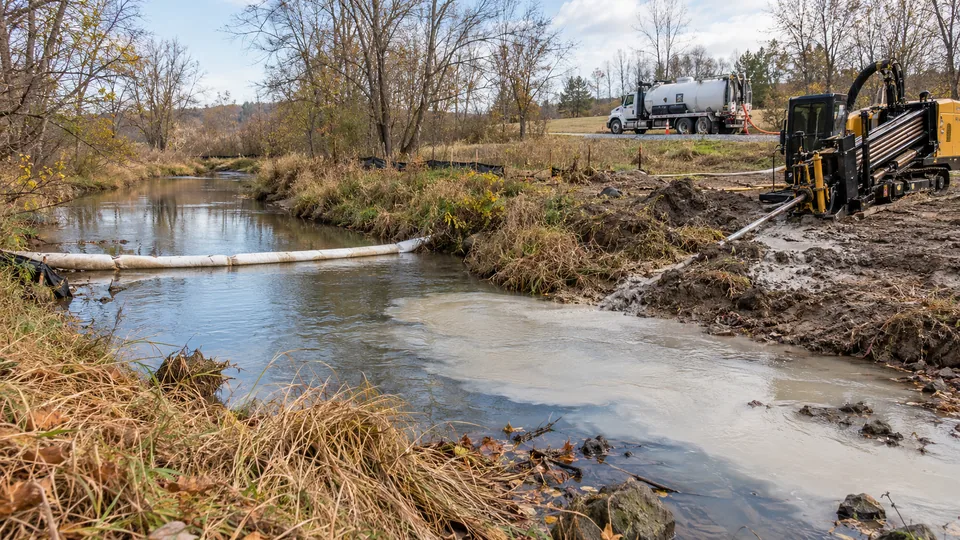
During pilot boring and reaming, the driller pumps drilling fluid downhole to carry cuttings out, cool the tooling and hold the bore open. When annular pressure exceeds what the overlying soil can confine, the fluid follows a fracture, an old utility trench or a gravel lens to the surface. In a dry field that is a muddy patch. Under a creek, it is a turbid plume in the water column. Under a street, it can lift pavement, fill a storm inlet or push slurry into a basement.
Drilling fluid is mostly bentonite clay and water, often with polymers, soda ash or other additives. Many contractors assume that makes a frac-out an ordinary property damage event. GL pollution exclusions are not written that way. They typically define pollutants as any solid, liquid, gaseous or thermal irritant or contaminant, and an insurer can argue that a slurry clouding a stream or clogging a storm system fits. A total pollution endorsement narrows any remaining exceptions further.
The pillar page on contractors pollution liability walks through definitions, triggers and endorsements in general. Here the focus is narrower: what a frac-out costs, which of those costs a CPL form may answer and what the driller should put in its submission so the form fits HDD work.
For the general framework, read what the GL pollution exclusion and CPL forms say.
Where the Money Goes After Drilling Fluid Surfaces
A return into a waterway usually triggers stopping the drill, deploying containment, pumping fluid from the bed with vacuum trucks, monitoring turbidity downstream and restoring the bank or bed once the bore is complete. Agency staff may require a revised drilling plan before work restarts. A return into a street adds traffic control, pavement repair, storm drain jetting and claims from property owners whose driveways, yards or lower floors took slurry.
Those costs fall into different buckets. Containment, removal and restoration ordered by an agency or demanded by the owner are cleanup costs that a CPL form may address. Damage to a neighbor's property and loss of its use are third-party property damage, which the CPL may also address when pollution is the cause. Redrilling the bore on a new alignment, crew and rig standby, lost production and liquidated damages for the delay are business losses, and pollution forms are not generally written to pay them.
That split is why a driller's frac-out budget generally should not rest on the policy limit alone. The deductible, any sublimit for emergency response and the gap between insured cleanup and uninsured downtime decide what a return costs the company.
Downtime, rig and tooling questions belong to the full insurance and bond program for HDD contractors.
Waterway Crossings: Permits That Anticipate Returns
Federal permits for utility crossings already assume returns can happen. In the January 8, 2026, reissuance of the nationwide permits, effective March 15, 2026, through March 15, 2031, the U.S. Army Corps of Engineers kept language in NWP 12 for oil and gas pipelines, NWP 57 for electric and telecommunication lines and NWP 58 for water and other utility lines that authorizes, to the extent Corps authorization is needed, temporary structures, fills and work needed to remediate inadvertent returns of drilling fluids to waters of the United States. Remediation must be done as soon as practicable, and district engineers may add special conditions requiring a remediation plan.
State rules add their own duties. In California, Fish and Game Code §1602 requires notice to the Department of Fish and Wildlife before an activity that may substantially change the bed, channel or bank of a river, stream or lake or deposit material into it, and CDFW notes that this includes waterways that are dry for part of the year. In Texas, Water Code §26.039 defines other substances to include materials not ordinarily considered waste that will cause pollution if discharged into water, and it requires notice to TCEQ as soon as possible and not later than 24 hours after an accidental discharge. Arizona's A.R.S. §49-255.01 bars discharges except under an AZPDES permit.
None of these permits is insurance, and none of them pays for anything. They do shape the cleanup obligation, which is what the CPL cleanup grant is measured against. A policy that pays only when cleanup is required by environmental law can respond differently from one that also pays owner-demanded or emergency response costs.
Large river or wetland crossings sometimes warrant a project pollution policy for a major crossing.
Street and Storm Drain Returns in Developed Areas
In metro areas, many returns surface under pavement rather than under rivers. Telecom, fiber and power conduit bores in residential streets cross old trench backfill, utility vaults and storm laterals, all of which give pressurized fluid an easy path. Slurry that reaches a storm inlet is a discharge to the municipal storm system, and the city's stormwater staff may require cleaning, inspection and reporting at the contractor's cost.
Highway owners pay attention too. ADOT's encroachment permit guidelines require a bore profile and plan for any facility installed by horizontal directional drilling in its right-of-way, along with a stormwater pollution prevention plan where impacts exceed regulatory limits. Caltrans requires utility crossings in state highway right-of-way to be trenchless and asks for dewatering and contingency plans on bores larger than 10 inches with shallow cover. Those submittals are useful underwriting documents because they show the driller planned for fluid control.
For coverage, a street return raises the same questions as a creek return plus one more: whether pavement heave caused by fluid pressure is treated as pollution damage, as ordinary property damage under the GL or as damage to the work the contractor is performing. The answer can shift the claim between policies, so the adjuster's first read of the facts matters.
The same permits often require encroachment permit bonds for right-of-way work.
Five CPL Provisions to Read Before the Next Crossing
Not every contractors pollution form fits a drilling operation. Some are written for general contractors and list operations by class, some exclude subsurface work or certain drilling methods and some limit the cleanup grant to government-mandated work. A driller should read the form with five provisions in mind, and ask the underwriter to answer each in writing.
- Covered operations: horizontal directional drilling, pilot boring, reaming and pullback named, including work as a subcontractor.
- Pollutant definition: broad enough to include drilling fluid, bentonite, polymers and cuttings rather than only hazardous substances.
- Cleanup trigger: government-ordered, owner-demanded and emergency response costs, and whether voluntary containment is reimbursed.
- Natural resource and water exposures: no exclusion for discharges to waterways, wetlands or groundwater.
- Defense and deductible: whether defense sits inside the limit and whether one deductible applies per pollution condition or per claimant.
Drillers who also trench and tie in should compare pollution exposures across underground utility work.
Frac-Out Plans, Notice and the Claim File
Owners, agencies and permit conditions increasingly require an inadvertent return contingency plan: monitoring of annular pressure and returns, staged containment materials, a stop-work trigger and a notification list. Writing that plan with the insurance notice built into it costs little and protects the claim. The plan should name who calls the agency, who calls the owner and who reports the event to the pollution insurer before the shift ends.
Claims-made pollution forms respond only to claims first made and reported during the policy period, and occurrence forms still carry notice conditions. A return that seemed minor in the field can grow into a restoration demand weeks later, so report early and keep the drilling logs, fluid volumes pumped versus returned, photos and agency correspondence. Those records also support any later argument that the return came from a pre-existing fracture or an abandoned line rather than poor fluid management.
How bore work, retroactive dates and endorsements affect the premium is explained in how underwriters price drilling on a pollution policy.
Before You Ask for a Quote
What to Gather
- Current CPL policy or quote, including the covered operations schedule and cleanup trigger wording
- GL pollution exclusion or total pollution endorsement from the current policy
- Bore plans and profiles for the crossings in the next 12 months, with depths and soil information
- Inadvertent return contingency plan and the drilling fluid products used, with safety data sheets
- Permit conditions for waterway, highway and railroad crossings on the current backlog
- Frac-out and return history for the past five years with volumes and costs
- Subcontract and owner exhibits that name pollution limits or additional insureds
What to Ask the Insurer or Surety
- Is horizontal directional drilling named as a covered operation, including work as a subcontractor?
- Does the pollutant definition reach bentonite, polymer additives and cuttings?
- Does the cleanup grant include owner-demanded and emergency response costs, or only agency orders?
- Is there any exclusion for discharges to waterways, wetlands or groundwater?
- How is the deductible applied when one return produces cleanup and several third-party claims?
- Can the general contractor and owner be additional insureds on the CPL with primary wording?
Quick Answer
A frac-out is often treated as a pollution event, so the GL may not respond. A CPL form that names HDD, defines pollutants to include drilling fluid and pays owner- or agency-required cleanup may address containment, restoration and third-party damage, but not redrilling or downtime.
Common Mistake
Treating bentonite as harmless and therefore outside the pollution exclusion. Insurers can read drilling fluid in a creek or storm drain as a contaminant, which leaves cleanup uninsured if no CPL is in place.
Broker Perspective
A broker checks that the CPL's covered operations and cleanup trigger match how HDD crews work, as subcontractors on owner-driven schedules, and that the frac-out plan's notice steps line up with the policy's reporting conditions.
Coverage Impact
Coverage typically depends on the covered operations schedule, the pollutant definition, the cleanup trigger and any water-related exclusions. Fines, rig standby, redrilling and delay damages are commonly outside pollution policies.
Questions Buyers Ask
Bentonite is clay and water. Why would an insurer call a frac-out pollution?
Because many GL pollution exclusions define pollutants as any irritant or contaminant, and slurry clouding a stream or filling a storm system can fit that reading. The composition of the fluid matters less than where it went and what it damaged. A contractors pollution policy that names drilling fluid removes much of that argument.
Will a pollution policy pay to redrill a bore after a frac-out?
Usually not. Redrilling on a new alignment, rig standby and project delay are business costs rather than cleanup or third-party damage. A CPL form may address containment, removal, restoration and claims from affected owners, so budget for downtime separately and read the subcontract's delay and liquidated damages terms.
Do we need a remediation plan for inadvertent returns on a creek crossing?
Often. The 2026 Corps nationwide permits for pipeline, electric, telecom and water utility lines let district engineers add conditions requiring a remediation plan for returns to federal waters, and owners commonly require a contingency plan anyway. State agencies such as CDFW may set their own conditions. Share the plan with your pollution underwriter.
Who reports a frac-out in Texas, the driller or the owner?
Texas Water Code §26.039 puts the notice duty on the person operating, in charge of or responsible for the activity, within 24 hours of an accidental discharge into water. On most bores that includes the drilling contractor. Agree in the subcontract who calls TCEQ, and notify your pollution insurer promptly.
Is slurry that comes up in a street treated differently from a creek return?
It can be. A street return may produce storm drain cleaning demands, pavement repair and claims from property owners, and pavement heave can be argued as ordinary property damage under the GL rather than pollution. Which policy answers depends on the facts and wording, so report to both insurers and let them sort the allocation.
Official Sources
- Reissuance and Modification of Nationwide Permits (Federal Register, January 8, 2026), U.S. Army Corps of Engineers, Federal Register. NWPs effective March 15, 2026, and expiring March 15, 2031; NWP 12, 57 and 58 authorize remediation of inadvertent returns of drilling fluids from HDD and allow district engineers to require a remediation plan. Verified 2026-10-24.
- CDFW, Lake and Streambed Alteration Program (Fish and Game Code §1602), California Department of Fish and Wildlife. Notice to CDFW before activities that may substantially change the bed, channel or bank of a river, stream or lake or deposit material into it; includes waterways dry for periods of time. Verified 2026-10-24.
- Tex. Water Code §26.039 (accidental discharges and spills), Texas Legislature. Definition of other substances; notice to TCEQ as soon as possible and not later than 24 hours after an accidental discharge or spill by the person operating or responsible for the activity. Verified 2026-10-24.
- A.R.S. §49-255.01 (AZPDES discharge permits), Arizona State Legislature. A person shall not discharge except in conformance with a permit issued or authorized under the AZPDES program. Verified 2026-10-24.
- ADOT Encroachment Permits Guideline and Procedures (2026), Arizona Department of Transportation. Bore profile and plan required for facilities installed by horizontal directional drilling; SWPPP where impacts exceed regulatory limits. Verified 2026-10-24.
- Caltrans Encroachment Permits Manual, Chapter 600 (Utility Permits), California Department of Transportation. Section 603.6: underground utilities in state highway right-of-way must be trenchless; 603.6A-5B supporting documents include dewatering and contingency plans on larger bores. Verified 2026-10-24.
Reviewed by the Principal, Gleason Insurance Brokers, LLCUpdated