
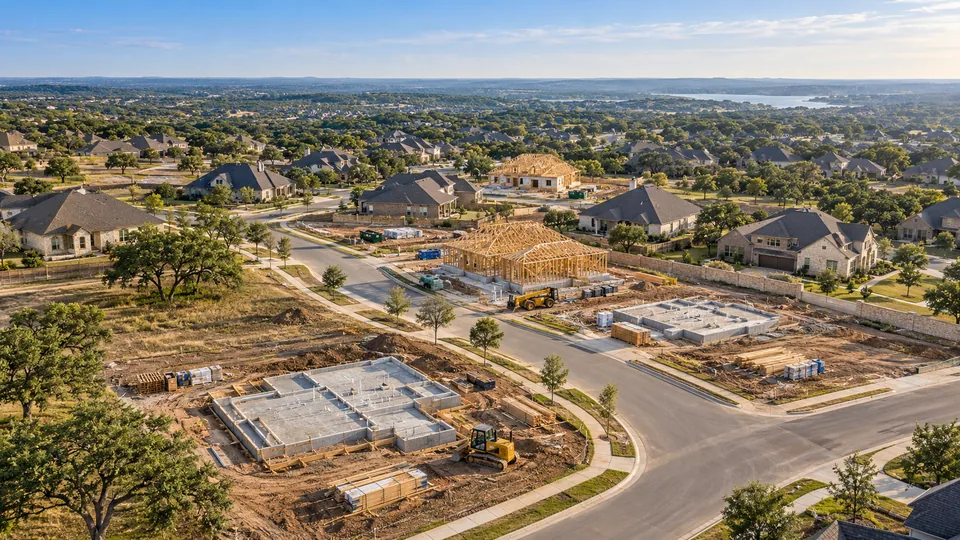
Prosper's Growth and Where the Town's Rules Come From
Prosper is growing fast enough that its engineering documents get heavy use. The Town's FY 2026-2027 preliminary budget book puts the population at 49,355 as of January 1, 2026, and counts 8 active residential subdivision phases, with an additional 1,193 lots that are shovel ready, under construction or in plan review. New construction added $607,241,178, or 5.6%, to taxable value.
The bond and acceptance rules sit in several places. The Subdivision Ordinance, which the Development Manual identifies as Ordinance 17-41, governs plats and final acceptance under Section 5.05. The Development Manual, the Engineering Design Standards, the Final Acceptance Process and the residential acceptance checklist add the working detail. Their dates differ, and that matters for the maintenance bond figure discussed below.
Prosper's requirements are its own. Developers comparing nearby towns will find different percentages and procedures in each, so a program built for one town's plat typically needs adjustment for the next.
For a nearby comparison, see Frisco development bond requirements.
The Maintenance Bond: 100% in Current Documents, 10% in a 2019 Guide
At closeout, the 2023 Development Manual, whose cover reads Updated August 2022, calls for a two-year maintenance bond for 100% of the public improvement costs. The Engineering Residential Final Acceptance Checklist says the same in its own words, asking for a bond that covers 100% of construction costs for a two-year period, and it asks for separate maintenance bonds for the utilities, paving and subgrade contracts.
The Town's Commercial Inspection Guideline, revised in April 2019, states a two-year maintenance bond for 10% of public improvement costs. That is a tenfold difference on the same kind of work. The newer documents say 100%, but we could not confirm which figure the Town applies to a commercial project today. Ask Town Engineering in writing before the surety prices the bond, especially on commercial or mixed-use sites.
The checklist also asks for an affidavit that the contractor has been paid at least 90% of the contract or in full. A surety writing a 100% maintenance bond for a utility, paving or subgrade contractor will typically want to see that payment picture and the acceptance date, since the two-year term runs from there. Bond terms are subject to underwriting and the terms of the bond issued.
- 2023 Development Manual (updated August 2022): two years, 100% of public improvement costs.
- Residential Final Acceptance Checklist: two years, 100% of construction costs, one bond each for utilities, paving and subgrade.
- Commercial Inspection Guideline (revised April 2019): two years, 10% of public improvement costs.
How Texas towns and counties use plat and improvement security is explained under Texas subdivision improvement bonds.
Performance Security Is Set in the Subdivision Ordinance
The percentage, form and timing of any performance bond or letter of credit for platting are set in the Town's Subdivision Ordinance. We could not read that text for this page, so we do not state a figure. Confirm the current performance security terms with the Town before the surety commits capacity, and ask whether a bond, letter of credit or other instrument is accepted for your plat.
What the Town's public documents do show is how it handles work that cannot be built yet. The Development Manual says any required improvements unable to be installed at the time of development must be escrowed before final acceptance. The Final Acceptance Process adds that escrow is required where an adjacent road is not built to its ultimate section.
Escrow, Engineering and Inspection Fees
Section 4 of the Engineering Design Standards, updated July 2020, sets the escrow amount: it includes all construction costs plus engineering at 7% of construction cost and inspection at 3% of construction cost. On a deferred turn lane or a half-built thoroughfare, the developer funds roughly 110% of the construction estimate in cash rather than through a surety, which affects equity and loan budgets more than bond capacity.
The Development Manual separately lists an inspection fee of 3% of public improvement construction costs and says roadway, water and wastewater impact fees are collected at time of development. Developers also build deceleration lanes and median openings on the TxDOT roads that run through Prosper, which the manual lists as US 380, SH 289 (Preston), FM 1193, FM 1385, FM 1461 and FM 2478 (Custer).
The manual also notes that Prosper holds an ISO Class 1/1X rating for property insurance classification. That rating is one factor a property carrier may consider on completed buildings; how much it affects a builders risk or property quote can vary by carrier guidelines and programs.
How Texas developers budget for bonds, escrow and insurance is summarized under Texas developer insurance and bond requirements.
Final Acceptance Comes Before Home Permits
The Town's Final Acceptance Process, updated 2024, says final acceptance is required for all projects with public infrastructure, and it must come before any residential home permit and before any certificate of occupancy or temporary certificate of occupancy. For a subdivision, that puts the maintenance bonds, the payment affidavits and any escrow on the critical path to the first home start.
Builders buying lots should plan for that sequence. Builders risk start dates, lot takedown schedules and the homebuilder's own insurance typically follow the Town's acceptance date, and the subcontractors' completed-operations coverage should run at least as long as the two-year maintenance bond that begins there.
How liability coverage applies after the Town accepts the work is explained under completed-operations liability after acceptance.
Right-of-Way Registration and Town Insurance Terms
Contractors and subcontractors working in Prosper right-of-way must register with the Town. The Right-of-Way page asks for the registration form and a current certificate of insurance, and it says the Town of Prosper will need to be added to the insurance. The right-of-way pre-construction handout asks for a completed certificate before work starts, citing code section 13.08.162. No right-of-way permit bond was stated on either page.
The Town also publishes Insurance Requirements for Construction Services. That document applies to contractors working under a contract with the Town, not to private developers as stated. For Town-contract work it calls for general liability of $1 million per occurrence and $2 million aggregate on an occurrence form including XCU, $1 million auto liability, a $1 million umbrella, builder's risk at completed value with the Town as loss payee, the Town as additional insured on a primary and noncontributory basis, a waiver of subrogation on workers' compensation and 30 days' notice.
A private developer's contractors should not assume those limits apply to their right-of-way registration, or that they do not. Ask Town Engineering what limits and endorsement wording it expects on a right-of-way certificate, and keep the certificate current so registration does not lapse at renewal.
Permit bonding and insurance on Texas town and county roads is explained under Texas right-of-way permit bonds and insurance.
Before You Ask for a Quote
What to Gather
- Engineer's construction cost estimates for the utility, paving and subgrade contracts
- Written confirmation from Town Engineering of the maintenance bond percentage for your project type
- Escrow calculations for deferred improvements, including 7% engineering and 3% inspection
- Contractor payment status for the at-least-90% affidavits at final acceptance
- Right-of-way registration forms and current certificates of insurance naming the Town
- Plat and performance security terms confirmed with the Town under the Subdivision Ordinance
What to Ask the Insurer or Surety
- Does the Town apply the 100% or the 10% maintenance bond figure to this project?
- Will each contractor's surety write a 100% two-year maintenance bond for its contract?
- What performance security does the Subdivision Ordinance require for our plat, and in what form?
- What limits and endorsements does Town Engineering expect on a right-of-way certificate?
- Do the Town-contract insurance requirements apply to any part of our work, such as a Town-funded segment?
- Does each contractor's completed-operations coverage run through two years after final acceptance?
Quick Answer
Prosper requires final acceptance before home permits or COs, a two-year maintenance bond at 100% of public improvement costs in its current documents (10% in a 2019 commercial guideline), escrow at cost plus 7% and 3% and right-of-way contractors naming the Town on insurance.
Common Mistake
Applying the Town's $1 million and $2 million construction services limits to every private right-of-way permit. That document addresses Town-contract work; confirm what Town Engineering expects for a private developer's contractors.
Broker Perspective
A broker confirms the maintenance bond percentage with the Town in writing, arranges full-value bonds for each contract and tracks right-of-way certificates so the Town stays named at renewal.
Coverage Impact
Three 100% maintenance bonds tie up surety capacity for two years after acceptance, and escrow uses cash, so a Prosper phase can strain both credit and liquidity at the same time.
Other Dallas-Fort Worth Cities
Questions Buyers Ask
Is the Prosper maintenance bond 100% or 10% of improvement costs?
The 2023 Development Manual (updated August 2022) and the residential final acceptance checklist say 100% for two years. The Commercial Inspection Guideline revised in April 2019 says 10%. The documents conflict, and we could not confirm which the Town applies to commercial work, so ask Town Engineering in writing.
Can a Prosper builder pull a home permit before final acceptance?
The Town's Final Acceptance Process, updated 2024, says final acceptance is required for all projects with public infrastructure and must come before any residential home permit and before any CO or TCO. Plan lot takedowns and builders risk start dates around that acceptance date.
How is a Prosper escrow for a deferred road calculated?
Section 4 of the Engineering Design Standards, updated July 2020, says the escrow includes all construction costs plus engineering at 7% and inspection at 3% of construction cost. Escrow applies to required improvements that cannot be installed at development and where an adjacent road is not built to its ultimate section.
Do the Town's $1 million and $2 million liability limits apply to a private developer's contractors?
The Insurance Requirements for Construction Services document addresses contractors working under a Town contract and is not stated to apply to private developers. Right-of-way contractors must register with a current certificate of insurance that adds the Town. Confirm the limits and wording Town Engineering expects for private work.
What performance bond does Prosper require to record a plat?
Performance security for platting is set in the Town's Subdivision Ordinance, which we could not read for this page, so we do not state a percentage. Confirm the amount, form and timing with the Town before the surety prices the bond.
Official Sources
- Town of Prosper 2023 Development Manual (cover: Updated August 2022), Town of Prosper. Two-year maintenance bond for 100% of public improvement costs at closeout; 3% inspection fee; improvements that cannot be installed are escrowed before final acceptance; developer-built deceleration lanes and median openings on TxDOT roads (US 380, SH 289, FM 1193, FM 1385, FM 1461 and FM 2478); ISO Class 1/1X; roadway, water and wastewater impact fees at time of development; Subdivision Ordinance 17-41. Verified 2026-10-25.
- Engineering Residential Final Acceptance Checklist, Town of Prosper Engineering. Separate maintenance bonds for the utilities, paving and subgrade contracts, each covering 100% of construction costs for two years; affidavit that the contractor has been paid at least 90% or in full. Verified 2026-10-25.
- Final Acceptance Process (updated 2024), Town of Prosper Engineering Services. Final acceptance required for all projects with public infrastructure, before any residential home permit and before any CO or TCO; governed by Section 5.05 of the Subdivision Ordinance; escrow where an adjacent road is not built to its ultimate section. Verified 2026-10-25.
- Engineering Design Standards, Section 4: Thoroughfare and Circulation Design Requirements (updated July 2020), Town of Prosper. Escrow includes all construction costs plus engineering at 7% and inspection at 3% of construction cost. Verified 2026-10-25.
- Commercial Inspection Guideline (revised April 2019), Town of Prosper. Two-year maintenance bond for 10% of public improvement costs, which differs from the 100% figure in the newer Development Manual and residential checklist. Verified 2026-10-25.
- Right-of-Way (contractor registration), Town of Prosper. Contractors and subcontractors register with a registration form and a current certificate of insurance, with the Town of Prosper added to the insurance; no right-of-way permit bond stated. Verified 2026-10-25.
- Right-of-Way Pre-Construction Handout, Town of Prosper Engineering. A completed certificate of insurance is furnished before starting work, citing code section 13.08.162. Verified 2026-10-25.
- Insurance Requirements for Construction Services, Town of Prosper. For contractors under a Town contract: general liability $1 million per occurrence and $2 million aggregate on an occurrence form including XCU, $1 million auto, employer's liability, $1 million umbrella, builder's risk with the Town as loss payee, the Town as additional insured, primary and noncontributory wording, workers' compensation waiver of subrogation and 30 days' notice. Verified 2026-10-25.
- FY 2026-2027 Preliminary Budget Book, Town of Prosper. Population of 49,355 as of January 1, 2026; 8 active residential subdivision phases with an additional 1,193 lots shovel ready, under construction or in plan review; new construction added $607,241,178 (5.6%) to taxable value. Verified 2026-10-25.
Reviewed by the Principal, Gleason Insurance Brokers, LLCUpdated

